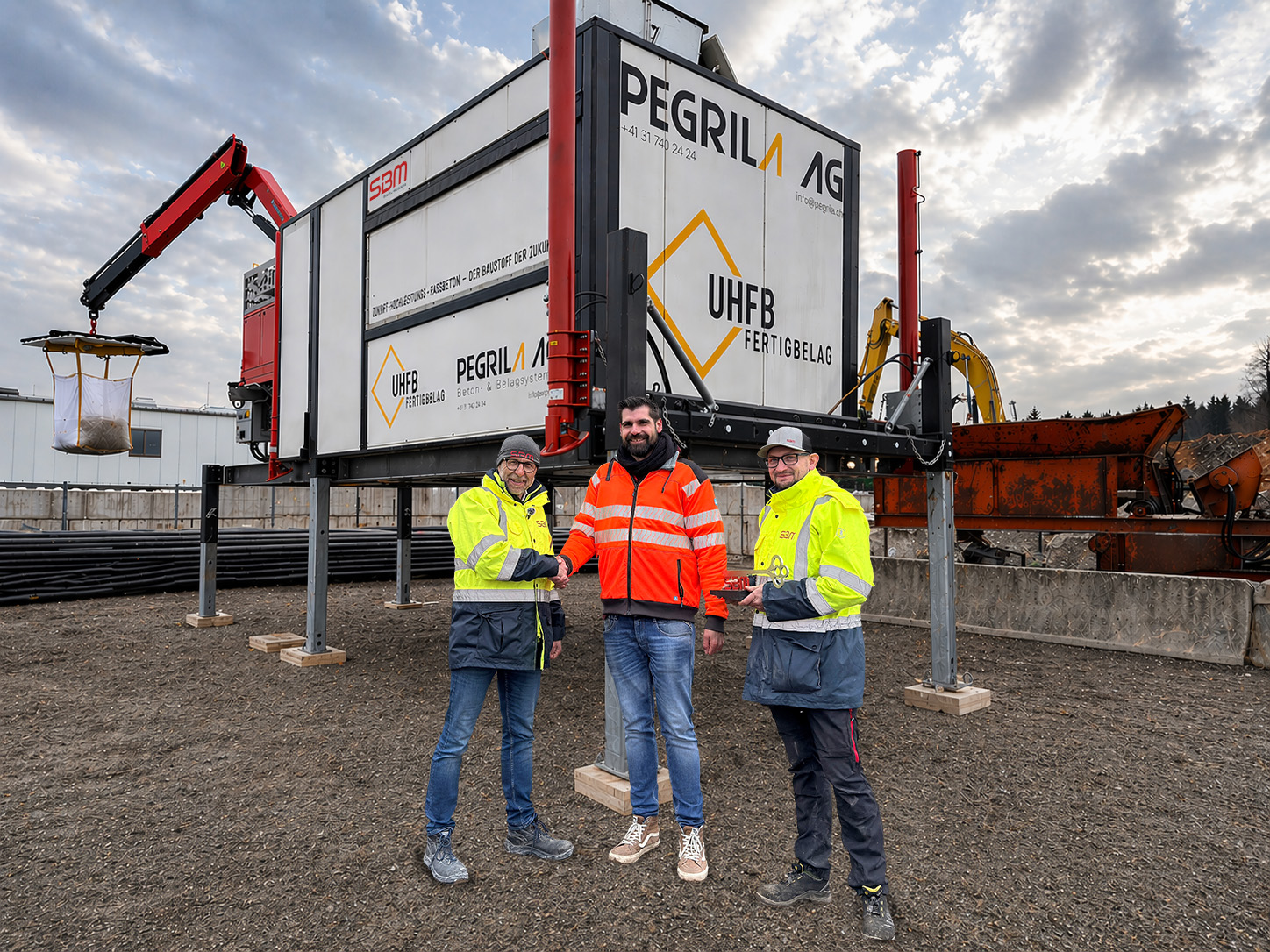


High-performance concrete for every site
The high-tech engineering company SBM Mineral Processing is presenting a new mobile mixing plant concept to produce ultra high-performance fibre reinforced concrete (UHPC). The fully integrated plant was developed by order of the company Berner Pegrila AG Beton- und Belagsysteme. Conceived specifically to adapt to changing site conditions, it delivers impressive results in practical use due to optimised processes, high throughput and short mixing cycles for all standard types of UHPC ready-mixed concrete. This makes it suitable for small traffic areas as well as the reconstruction of large-scale infrastructure projects.
For more than 20 years, Switzerland has been considered a pioneer for the use of UHPC. The SIA standard 2052 (2016) (SIA: Schweizer Ingenieurs- und Architektenvereinigung, Swiss Society of Engineers and Architects) laid the foundations for the certified production and paving of ultra-high-performance concrete at construction sites. Depending on the UHPC class, this modern building material makes it possible to construct fully trafficable just 30–40 mm thick surface layers, providing excellent impermeability to surface water and even aggressive substances, as well as direct static reinforcement of lanes, surfaces or supporting structures with high impermeability and durability. There is no need for costly structural work, and construction times are significantly reduced. In terms of maintenance and documented service life, professionally implemented UHPC surfaces also surpass conventional concrete constructions, which greatly compensates for the high construction costs starting at 6,000.00 CHF per cubic metre for high-performance concrete in large areas.
In accordance with the high demand, all major Swiss construction material producers supply ready-mixed materials to be used on construction sites today: On site, the premixes with all mineral aggregates, cement, admixtures and, in some cases, already precisely measured steel fibres are processed by adding fresh water and manufacturer-specific additives, such as plasticisers.
Processing and paving of UHPC require experienced specialists and specialised equipment: The material is sensitive to temperature and humidity, has a processing time of only 15 minutes and, with up to 280 kg of steel fibres per cubic metre, places particular demands on the mixing technology.
As a result, it is not only teams from large construction enterprises, but particularly specialised concrete contractors and surfacing companies that undertake their own UHPC projects or carry out individual trades throughout Switzerland on behalf of construction companies or building materials manufacturers. One of these ‘UHPC specialists’ is the Bern-based company Pegrila AG Beton- und Belagsysteme, which has been part of the Weiss+Apetito Group since 2017. In addition to offering a wide range of concrete for surfaces and traffic areas in both indoor and outdoor spaces, the company implements its own UHPC solutions for traffic, parking and storage areas. On behalf of clients, Pegrila AG Beton- und Belagsysteme also takes on individual UHPC trades and larger projects for renovation projects in the transport and infrastructure sectors. “Today, 30 to 40 per cent of our activities involve high-performance concrete – and the trend is growing, states Pegrila Managing Director Alexander Berger.
To better meet the particularly growing demand for large-scale projects, Pegrila decided already in autumn 2024 to invest in a high-performance, fully mobile UHPC mixing plant. The aim was to effectively expand the company's existing fleet of six forklift-mobile single mixers for small batches of up to 0.5 m³, but above all to make the company less dependent on cost-intensive rental equipment often unavailable at short notice when undertaking larger projects.
Usually, the production of high-performance concrete on site is limited to just a few work shifts. This means that high mobility, flexible positioning and autonomous operation of the mixing equipment used are all crucial. Although the semi-mobile plants, integrated hook lift platforms or lorry superstructures available on the market fulfilled these requirements – the latter, however, with limited load capacities and time-consuming processing cycles. Particularly with large-scale projects this complicates the tightly scheduled paving of UHPC thus impeding profitable area performance. Therefore, larger mixing batches, more efficient loading and concrete discharging, and consequently faster and automatically controlled mixing cycles were the key components of the requirements specification that Pegrila submitted to relevant vehicle and plant manufacturers – including the Austrian concrete technology specialist SBM Mineral Processing.
“These are exactly the projects plant manufacturers are waiting for,” explains SBM Sales Manager Christoph Feischl. Being responsible for concrete mixing plants in Switzerland and Western Austria, he coordinated the development of the new UHPC mixing plant together with Project Manager Hans-Georg Pointl from the initial enquiry all the way through to commissioning. ‘We were able to go all out: From the excellent building materials knowhow of our in-house concrete experts and our technology partners, through our long-standing experience in the development and construction of supermobile concrete mixing plants, right through to the short communication lines between technical design, constructive implementation and our own in-house steel construction and assembly expertise.
From October 2024 onwards the development took place in several project phases always in close coordination with Alexander Berger and his site managers. In mid-March 2025, the order was placed, and just under a year later, the new containerised mobile mixing plant was delivered.
"Initially, it was a typical “tailor-made” solution, but we quickly saw the potential of mobile UHPC mixing technology for us as a plant manufacturer. In view of the marketability of the new concept, we focused on applications that were as universal as possible and designed the plant accordingly. Furthermore, even during the prototype phase, we have already been committed to high industrial standards ensuring that all our mobile plants lead in terms of cost-effectiveness and long-term reliability,” summarises Christoph Feischl. “The fact that we had the opportunity to work with a Swiss customer, receiving direct feedback from the leading building materials supplier in what is arguably the most developed UHPC market, is certainly no disadvantage for the international market opportunities of our new concept.”
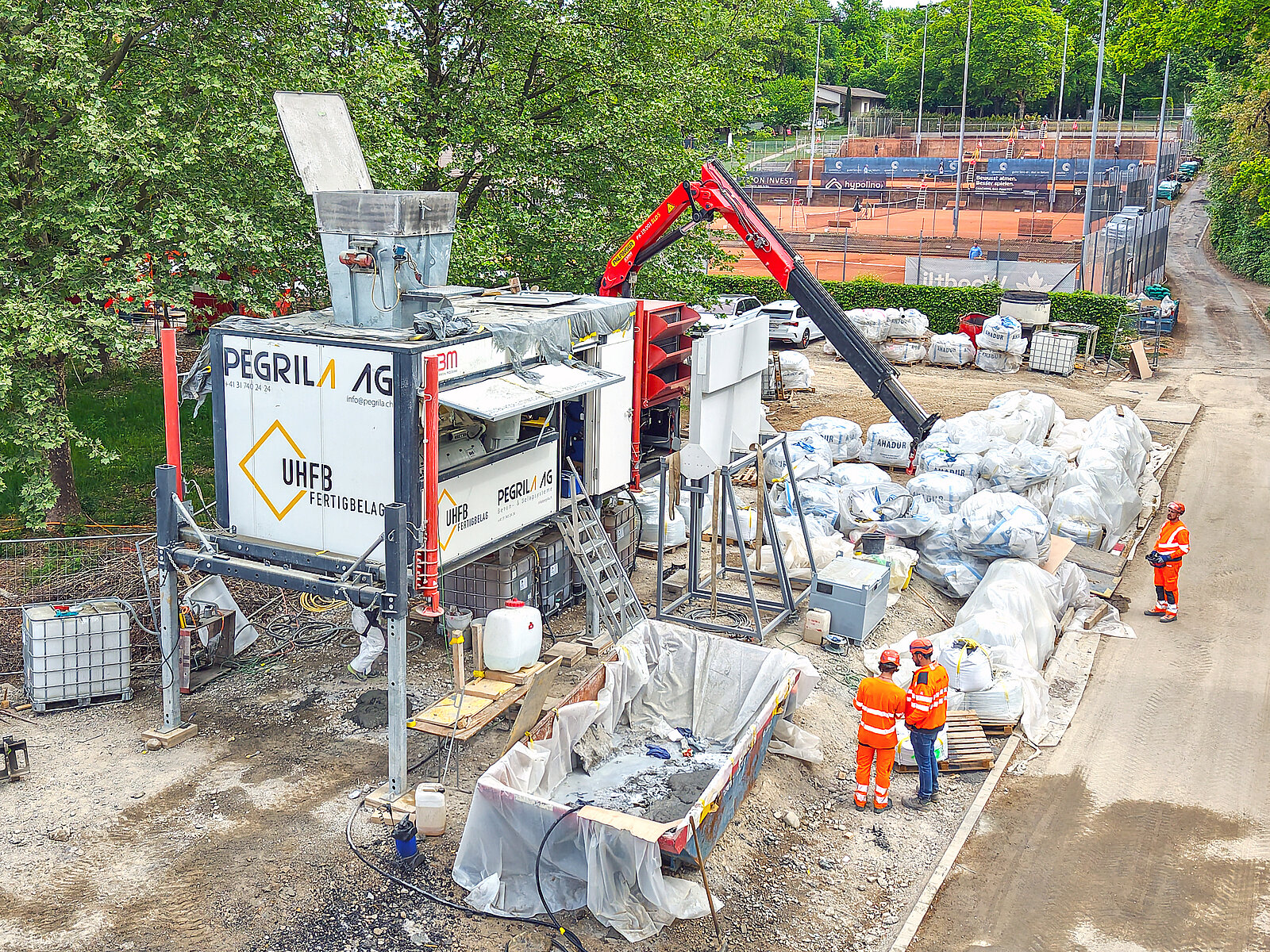
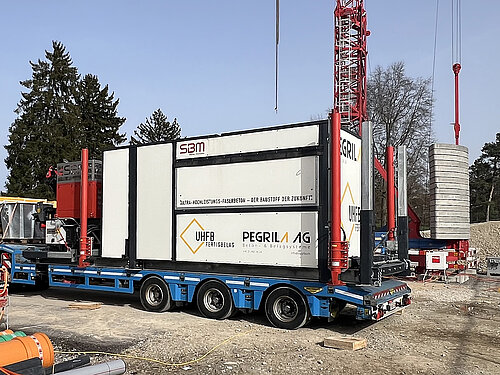
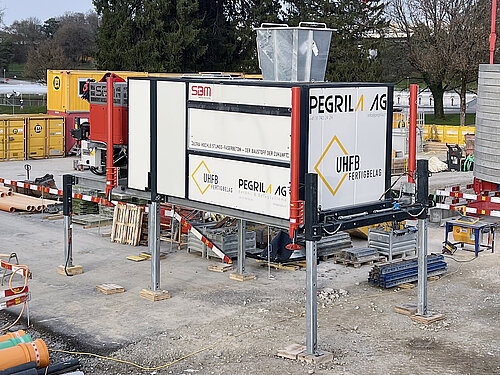
Featuring a Palfinger superstructure crane, a 220 kVA diesel generator unit and the complete mixing system housed within a dust-proof, winter-proof ISO enclosure, the new plant is supplied as a fully integrated system mounted on a base frame for low-bed trailer transportation. Thanks to four-point hydraulics and adjustable steel supports, it can be set up easily and fully by a single experienced operator within 45 minutes.
The centrepiece of the plant is the BHS DKX 1.67 S twin-shaft mixer with a double mixing mechanism. The well-established positive mixer delivers up to 1.0 m³ of UHPC per batch in just 8–10 minutes mixing time and is suitable for all UHPC types, including plastic fibre mixes. The frequency converter control of the powerful 75 kW drive allows for easy, mix-dependent adjustment of speed, lowering for visual inspections and discharge, as well as controlled intermediate mixing of the fast-setting fresh concrete e.g. in case of delays during concrete paving.
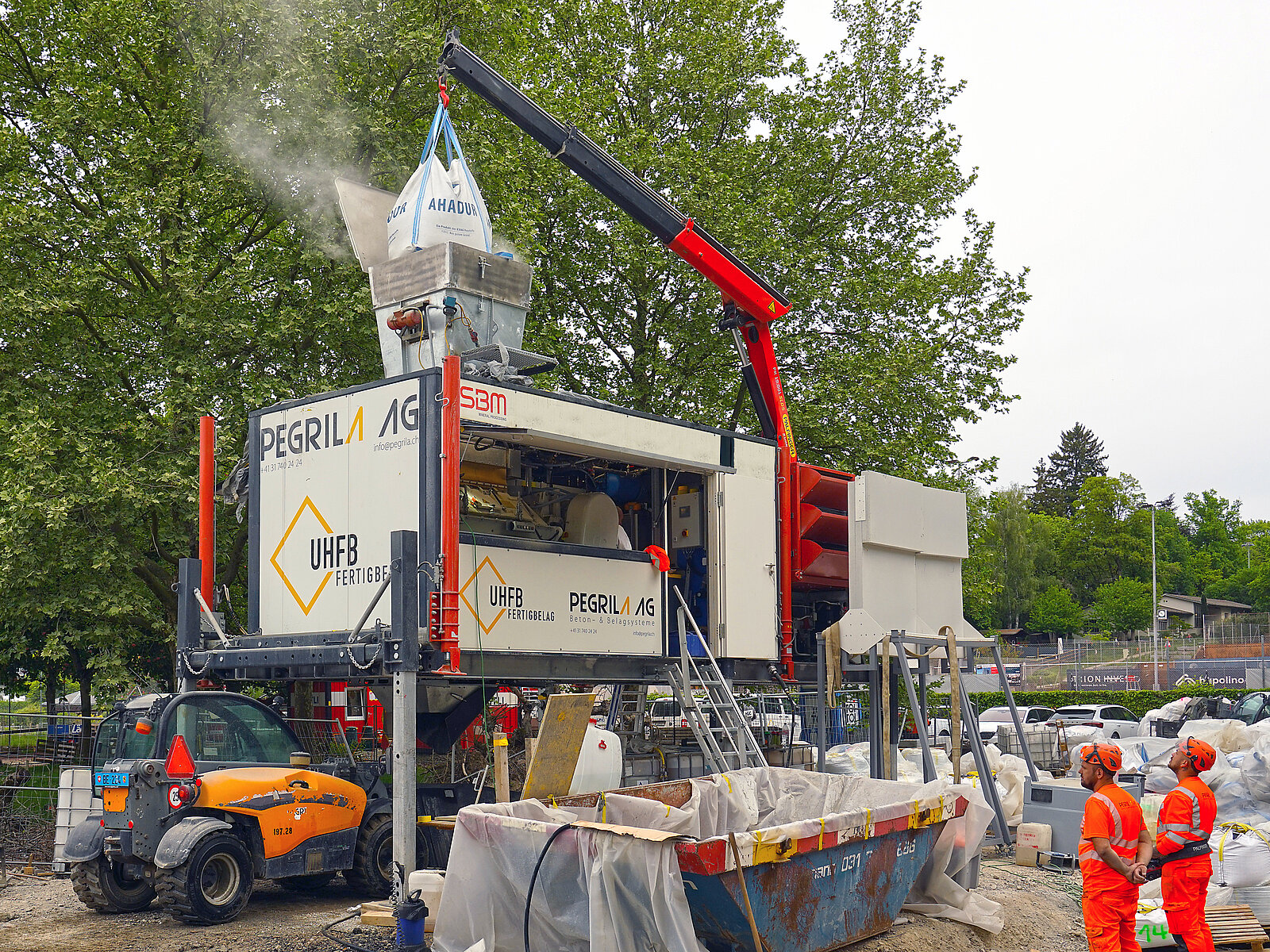
Due to the bottom clearance of the supporting system, fresh concrete can be discharged directly from the mixer to wheel loader buckets, dumpers, crane buckets, or concrete pumps – without requiring any time-consuming intermediate or final cleaning of conveyor belts or long chutes. This substantially speeds up the total cycle time per cubic metre of UHPC: Big Bag crane loading into the 1.0 m³ storage hopper, the automatic dosing of fresh water and additives from the tanks (1000 l / 750 l) and the short mixing process of individual batches significantly reduce the total cycle time to well under 15 minutes per cubic metre of UHPC.
A door with a stairway, large maintenance doors on both sides, and an internal access route to the roof platform ensure that the entire system is safely accessible for inspection and maintenance purposes. Additionally, the mixer is equipped with video surveillance and an automatic SBM high-pressure cleaning system. The control system controls all production processes in accordance with the specifications of the premix supplier. Via touchscreen, the mixing supervisor can easily and quickly adjust the weather-dependent or processing-relevant parameters based on current weather data or the requirements of the concrete paving team. All batches are continuously documented in accordance with all standards, which significantly reduces the workload of the workers compared to systems with manual weighing and dosing.
‘SBM has done an excellent job realising our vision. This applies to the innovative individual solutions, but above all to the fully equipped and technically sophisticated full package that the new plant now represents,’ says a satisfied Pegrila Managing Director Alexander Berger after take-over and first projects.
Due to its easy and simple transport and minimum set-up times, the plant can be profitably used even for smaller projects involving 6 to 8 m³ of high-performance concrete. Already during the first major project the new plant has proven its worth: In the course of the complete renovation of the historic KA-DE-WE Bern leisure centre (short for Kunsteisbahn und Wellenbad Dählhölzli) Pegrila renewed the concrete floor of the non-swimmer pool used as an artificial ice rink in winter between the end of April and mid-May on behalf of the main contractor Läderach Weibel. Covering a total area of 4,100 m², approximately 150 m³ of synthetic fibre UHPC construction class S applied in layer thicknesses of 35 to 45 mm now ensure durable waterproofing of the newly placed concrete cooling layer.
Positioned right at the edge of the paving area, the new SBM mixing plant with two mixing masters supplied the UHPC fresh concrete for the nine sections with areas ranging from 420 m² to 460 m², which was completed in 9 working days only. A KIBAG Premix Ahadur with a plastic fibre content of 38 kg/m³ was paved with the project-specific addition of wear-resistant silicon carbide (280 kg/m³) directly into the mixing plant. Even the required upstream dry mixing period in the BHS mixer (120 sec.) prolonged the processing cycles only marginally: The production of one cubic metre of fresh UHPC took only around 20 minutes from the crane loading of two 0.5 m³ Premix Big Bags each to discharge to the waiting 600-litre telescopic loading buckets.
‘This ensured that supplying the paving sites went smoothly despite delivery distances increasing to 500 metres,’ explains Alexander Berger. And even with the working hours restricted to 7:00 am to 5:00 pm out of consideration for the animals at the nearby Dahlhölzli Zoo the new plant never reached its limits. ‘Up to 18 cubic metres of UHPC were calculated for one stage; in fact, after only a short operating time, we were already achieving daily peaks of over 25 m³, which is a real record for the mobile sector.’